

Hey there! As a supplier of injection molding screws, I've been getting a lot of questions lately about the relationship between screws and mold cooling in injection molding. So, I thought I'd take a deep dive into this topic and share some insights with you all.
First off, let's talk about what injection molding is. It's a manufacturing process used to produce parts by injecting molten material into a mold. The screw in an injection molding machine plays a crucial role in this process. It's responsible for melting the plastic resin, mixing it thoroughly, and then pushing it into the mold cavity.
Now, mold cooling is equally important. Once the molten plastic is injected into the mold, it needs to cool down and solidify to take the shape of the mold cavity. Proper cooling ensures that the part has good dimensional accuracy, surface finish, and mechanical properties.
So, how do these two aspects - the screw and mold cooling - interact with each other?
The Screw's Impact on Mold Cooling
The screw affects mold cooling in several ways. One of the key factors is the heat generated during the plasticizing process. When the screw rotates and shears the plastic resin, it generates a significant amount of heat. This heat is transferred to the molten plastic, which then enters the mold.
If the screw generates too much heat, it can increase the temperature of the molten plastic. This means that the mold has to work harder to cool the plastic down to the solidification temperature. As a result, the cooling time increases, which can slow down the overall production cycle.
On the other hand, if the screw doesn't generate enough heat, the plastic may not be fully melted or mixed. This can lead to issues such as poor part quality, uneven shrinkage, and even blockages in the mold.
Another way the screw impacts mold cooling is through its design. Different screw designs have different plasticizing efficiencies and heat transfer characteristics. For example, a screw with a longer length-to-diameter ratio can provide better mixing and plasticizing, but it may also generate more heat.
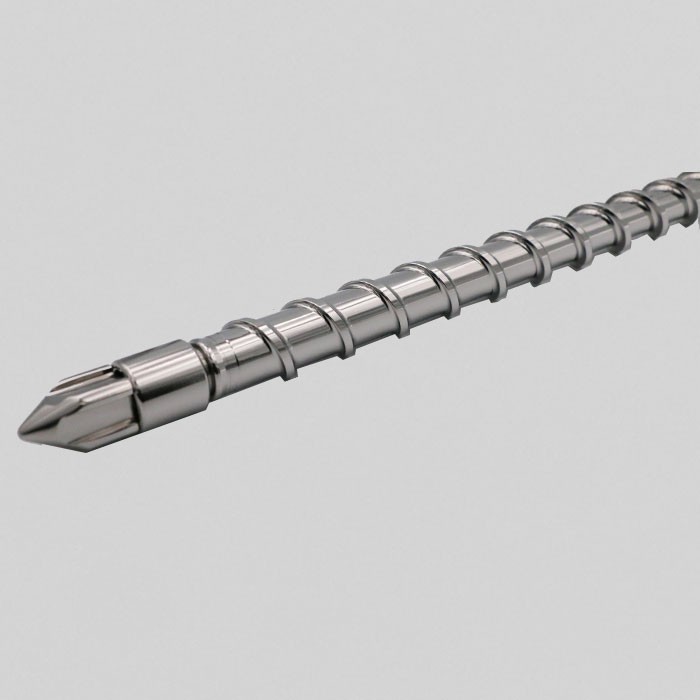
At our company, we offer a variety of screws to meet different customer needs. For instance, our Sintered Hard Alloy Screw for Injection Molding Machine is designed for high-performance applications. It has excellent wear resistance and can handle high temperatures, which can be beneficial in terms of both plasticizing and heat management.
Our Fully Hardened Alloy Screw for Injection Molding Machine is another great option. It's fully hardened throughout, which gives it superior strength and durability. This type of screw can help maintain a consistent plasticizing process, which in turn can have a positive impact on mold cooling.
Mold Cooling's Impact on the Screw
Mold cooling also has an impact on the screw. When the mold cools the molten plastic, it creates a temperature gradient within the mold cavity. This temperature difference can affect the flow of the molten plastic and the performance of the screw.
If the mold cooling is uneven, it can cause the plastic to solidify at different rates in different parts of the mold. This can lead to uneven pressure distribution within the mold, which can put additional stress on the screw. Over time, this can cause wear and tear on the screw, reducing its lifespan.
Proper mold cooling can also help prevent the screw from overheating. When the mold effectively removes heat from the molten plastic, it reduces the heat load on the screw. This can help keep the screw at a more stable temperature, which is beneficial for its performance and longevity.
Finding the Right Balance
To achieve optimal results in injection molding, it's essential to find the right balance between the screw and mold cooling. This requires careful consideration of several factors, such as the type of plastic resin, the part design, and the production requirements.
For example, if you're using a high-viscosity plastic resin, you may need a screw that can generate more heat to ensure proper melting and mixing. At the same time, you'll need an efficient mold cooling system to quickly cool the plastic down.
On the other hand, if you're producing a thin-walled part, you may need a screw that can provide a high injection speed to fill the mold cavity quickly. In this case, the mold cooling system needs to be designed to cool the part rapidly to prevent warping.
Our HVOF Coating Screw is a great choice for applications where heat management is crucial. The HVOF coating provides excellent wear resistance and heat insulation, which can help improve the screw's performance and reduce the heat transfer to the molten plastic.
Tips for Optimizing the Relationship
Here are some tips to help you optimize the relationship between the screw and mold cooling in your injection molding process:
- Choose the right screw: Select a screw that is suitable for the type of plastic resin and the part design. Consider factors such as the screw's length-to-diameter ratio, flight depth, and material.
- Design an efficient mold cooling system: Ensure that the mold has a well-designed cooling circuit to remove heat from the molten plastic effectively. Use techniques such as conformal cooling channels to improve cooling efficiency.
- Monitor and control the process: Regularly monitor the temperature and pressure of the molten plastic, as well as the temperature of the mold. Make adjustments as needed to maintain a stable process.
- Perform regular maintenance: Keep the screw and mold in good condition by performing regular maintenance. This includes cleaning, lubricating, and inspecting for wear and tear.
Conclusion
In conclusion, the relationship between the screw and mold cooling in injection molding is complex but crucial. The screw affects mold cooling through the heat it generates and its design, while mold cooling impacts the screw's performance and lifespan. By finding the right balance between these two aspects and following the tips mentioned above, you can improve the quality of your injection molded parts, increase production efficiency, and reduce costs.

If you're looking for high-quality injection molding screws or need advice on optimizing your injection molding process, don't hesitate to get in touch. We're here to help you find the best solutions for your specific needs.
References
- Throne, J. L. (1996). Polymer Rheology in Injection Molding. Hanser Publishers.
- Rosato, D. V., & Rosato, D. V. (2000). Injection Molding Handbook. Kluwer Academic Publishers.